
When Medicine Had No Answers by Marnin Kligfeld
A founder’s journey from personal diagnosis to advancing biological research in autism.
When our daughter Leah was two years old, she began talking and then lost her words and began acting in a very defended way. She avoided eye contact. She lived in a world that felt slightly out of reach.
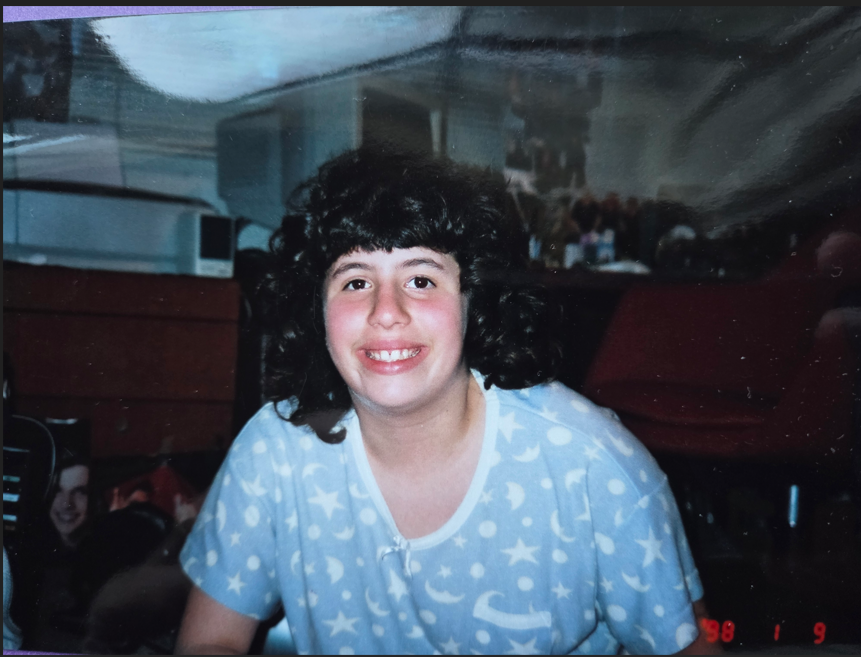
Leah
When we spoke to physicians and therapists about this, we were told we were overprotective parents.
At that time, autism was poorly understood. Awareness was limited. Evaluation pathways were inconsistent. Many physicians simply did not recognize what they were seeing.
At age 3 we finally saw the regional autism expert at Oakland Children’s Hospital. He looked at Leah on the exam table and said words no parent forgets:
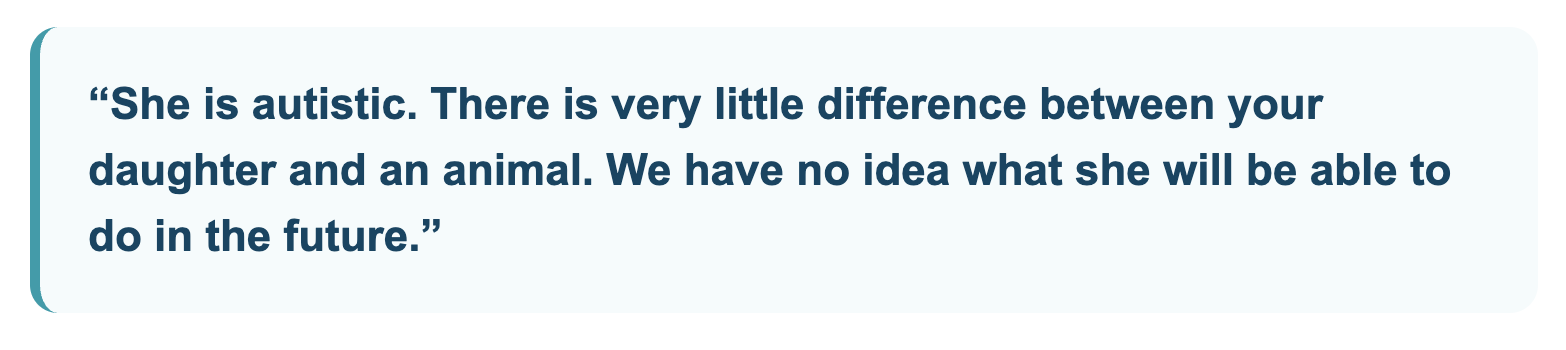
That was the frontline medical system in the early 1990s.
We were on our own.
What followed
What followed were many years of intensive, structured intervention:
Behavioral therapy
Occupational therapy
Speech therapy
Seven professionals working in our home, five days a week
The level of daily effort required of families like ours can only be described as heroic.
Leah made progress. We were lucky that she learned language, as many children with autism do not. She developed interests. She became a joyful, artistic, deeply feeling human being, much of this growth facilitated by her loving and devoted sister Rachel and the team that worked with her.
She is now 36 years old.
She is still deeply autistic.
She will never drive. She will never date. She will never have a family of her own or hold a conventional job.
But she is wonderful.
And she deserved better answers than we were given.
Autism is not abstract when it lives in your home
Leah’s first dental appointment required weeks of preparation.
We:
Took photos of the office and staff
Drove past the building repeatedly
Practiced sitting in the chair
Rehearsed steps without performing procedures
Asked the dentist to rename equipment to make it less threatening
Used a large mirror so she could see everything happening in real time
The goal of the first visit was simply to sit in the chair.
This is an example of the kind of daily orchestration many families navigate quietly.
Leah attended public schools with support through elementary, middle school and high school.
For the next 5 years, she insisted on staying home and we were able to hire incredibly gifted teachers and tutors to work with her in our home program.
After this period, Leah was finally willing to attend two wonderful day programs and enjoyed this time with her peers. She also accompanied us on weekly errands around town. With the COVID shutdown of day programs, her world narrowed again. When the day programs finally reopened, she was too anxious to return. She makes beautiful art daily, but still avoids people and prefers not to leave the house. Change remains profoundly difficult.
Autism evolves. Families adapt.
But uncertainty never disappears.
The absence of scientific clarity
What struck us most during those early years was not just the diagnosis.
It was the absence of scientific clarity.
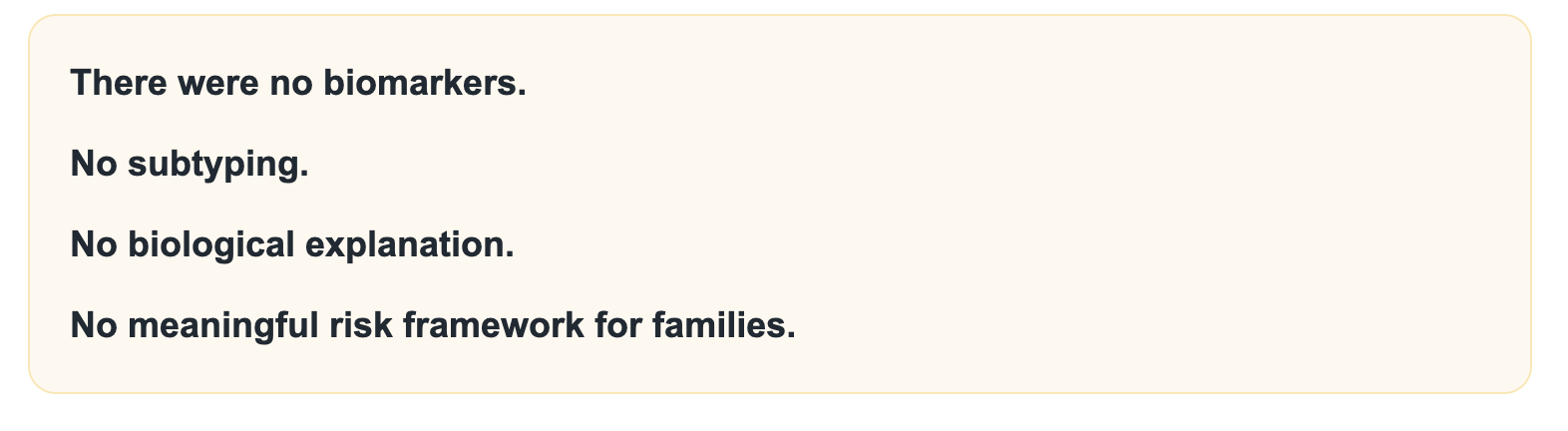
Autism research at the time was fragmented and, in some cases, polluted by unsound and misleading claims. Parents were vulnerable to misinformation because medicine offered so few concrete answers.
The system had failed to invest seriously in rigorous science.
That had to change.
Bringing serious science to autism research
In 2000, I joined the board of Cure Autism Now (CAN).
CAN launched one of the first structured academic grant programs dedicated to autism research at universities.
This mattered.
For the first time, meaningful funding flowed toward:
Immunology
Genetics
Neurodevelopmental biology
Rigorous academic investigation
CAN later merged into Autism Speaks, continuing the grant-giving initiative and expanding research investment nationwide.
The goal was simple:

I went to a MIND Institute event at UC Davis many years later, still searching for scientists who were conducting rigorous research that could help families like ours.
At that point, I never imagined that a biologically grounded pathway associated with a portion of autism cases might one day be identified. Then I met Judy Van de Water, Ph.D., Professor of Immunology at the UC Davis MIND Institute.
Her work on maternal autoantibodies and autism represented something different: carefully conducted, reproducible science pointing to a distinct immune-mediated subtype of autism.
In that moment, I knew I wanted to help bring this research out of the laboratory and into the world where it could benefit families.
I needed to help families like ours.
We are all members of a club none of us ever asked to join, but one we were thrust into.
From behavior to biology
For decades, autism has been described behaviorally.
But behavior is not mechanism.
Families deserve to understand:
Why risk exists
Whether recurrence risk may differ between families
Whether biological subtypes exist within the spectrum
Precision medicine begins with asking those questions.
When research began identifying maternal autoantibody patterns associated with increased likelihood of autism in a subset of children, it represented something profound:

For families like ours, that kind of science matters.
Not because it changes who our children are.
But because it replaces ambiguity with understanding.
Leah is not a statistic. She is not a case study. She is not a data point.
She is our daughter.
And she is part of why rigorous, ethical, translational science in autism matters.
The future of autism research will not be driven by speculation. It will be driven by reproducible biology. And families deserve nothing less.
Why this work feels urgent
But I often think back to those early years, before diagnosis, before intervention, when we knew something was different but could not get clear answers.
The absence of insight, and the inability to access the right expertise, kept us in the dark with our concerns. By the time we received a diagnosis, we had lost nearly a year of intervention during a period when the brain is most adaptable.
That time matters.
It is part of why this work feels so urgent to me.
Our hope is that advances in research, including tools like the MAR-Autism Test, can give families earlier perspective at a moment when it matters most. Not to change who a child is, but to reduce uncertainty, so families can monitor development more closely, recognize potential signs earlier, and access support sooner if needed.
For some, that additional insight may also play a role in future family planning decisions, whether that means preparing differently, or considering other paths.
And looking ahead, as the science continues to evolve, there is the possibility that one day we may be able to intervene at the biological level, preventing certain immune-related mechanisms from impacting early brain development.
That future is not here yet.
But for the first time, it feels grounded in real science.
And that is a meaningful shift, from not knowing, to beginning to understand.